

Most people don’t know what they’re actually buying when they hire an AEO agency. That’s not a criticism — it’s just the reality of a market that’s new enough that even sophisticated marketers haven’t had to evaluate these services before. The terminology is fuzzy, the deliverables aren’t standardized, and the measurement frameworks are still being built.
Which is exactly why having the right questions matters. You don’t need to know the answers before you walk into the room. You just need to know what to ask — and how to evaluate what comes back.
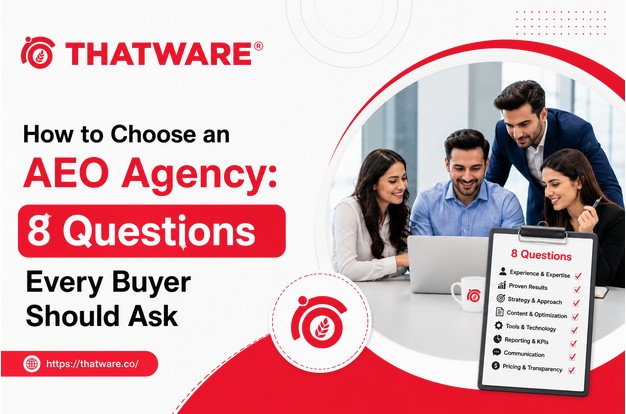
Here are eight questions that will tell you most of what you need to know.
1. “How do you define success for an AEO engagement?”
Start here. Every agency will have a different answer, and that’s actually useful — it reveals their mental model. Do they talk about AI citation frequency? Brand mentions in LLM outputs? Appearances in Google AI Overviews? Traffic from AI-referred sources?
Be wary of any agency that immediately pivots to traditional metrics like organic search rankings or monthly traffic. Those things may correlate with AEO success, but they’re not the same thing, and an agency that can’t distinguish them is probably treating AEO as rebranded SEO.
2. “Can you explain your methodology for building entity authority?”
Entity optimization is one of the foundational pillars of AEO — and it’s also one of the areas where agencies vary most dramatically in their sophistication. Some firms genuinely understand how knowledge graphs work, how brands become recognized entities in systems like Google’s Knowledge Graph or Wikidata, and how to systematically build entity signals across the web. Others use the term without understanding the mechanics.
Asking this question reveals which camp you’re dealing with pretty quickly.
3. “How do you approach content differently for AI answer systems vs. traditional search?”
This is a test of whether the agency has a genuinely differentiated AEO practice or just a repositioned content marketing service. The answer should reference things like: question-based content architecture, passage-level optimization (where individual sections of content are designed to stand alone as answers), conversational query targeting, and how they think about content credibility signals for LLMs.
A generic answer about “high-quality, informative content” isn’t wrong — but it’s not sufficient, either.
4. “What does your off-site strategy look like for AEO?”
AEO isn’t only about what’s on your website. A significant part of building AI citation authority involves your presence in third-party sources — industry publications, Wikipedia (where relevant), authoritative databases, news coverage, and other credible external references. LLMs form their picture of your brand from the full information ecosystem, not just your own content.
An agency that can only speak to on-site optimization is missing a major lever. Part of how to choose an AEO agency is assessing this off-site sophistication specifically.
5. “How do you handle factual accuracy and consistency across our web presence?”
LLMs are sensitive to inconsistency. If your website says one thing about your company, your LinkedIn profile says another, and your Wikipedia entry (if you have one) says something slightly different — models can get confused, or worse, pick up inaccurate information.
A good AEO agency has a process for auditing and maintaining factual consistency across all the surfaces where information about your brand lives. If they don’t have an answer to this question, that’s a gap.
6. “How do you measure and report on AI citation performance?”
We’re honest about the fact that this is still an evolving area. Perfect measurement tools don’t exist yet. But agencies shouldn’t use that as cover for not measuring at all.
The best firms have built frameworks for tracking: how often their clients’ brands appear in AI-generated answers (sampled across a range of queries), how Google AI Overview appearances change over time, what content pieces are driving citation events, and how to correlate AEO activities with measurable business outcomes. Ask for specifics. Vague answers about “monitoring the AI landscape” aren’t good enough.
7. “Do you have experience in our industry specifically?”
AEO looks meaningfully different across verticals. Healthcare requires navigating regulatory sensitivities and medical accuracy standards. Fintech demands extreme precision in factual claims. SaaS needs use-case-specific optimization that speaks to very specific buyer queries. Legal and professional services require different credibility signals than consumer brands.
An agency that has done great work in one industry may or may not translate cleanly to yours. It’s a legitimate question, and a credible agency will answer honestly — including acknowledging where they have less experience.
8. “What does the first 90 days look like?”
This is a practical, grounding question that tells you a lot about how an agency actually works. A strong answer will describe: a diagnostic phase (auditing current AI presence, identifying gaps), a strategy phase (content prioritization, entity mapping), and an initial execution phase (specific deliverables with clear timelines).
An agency that jumps straight into execution without a diagnostic first is a yellow flag. Effective AEO agency work starts with understanding where you currently stand — not just applying a generic template.
How to Use These Questions
You don’t need to run through all eight in a formal checklist format. In a good conversation, many of them will get answered organically. The goal is to ensure that by the end of your evaluation process, you have substantive answers to all eight — not just reassuring soundbites.
Pay attention to how agencies handle the hard questions. Do they engage thoughtfully, or do they deflect? Do they acknowledge uncertainty, or do they project false confidence? Do their answers show genuine understanding of how AI systems work?
The right agency is out there. These questions are how you find them.